Voiceclone guide
For is voice clone safe reddit searches: start with consent
If you searched is voice clone safe reddit, the useful question is not whether the technology is safe in every situation. A voice clone can be used responsibly when the speaker agrees and the output is clearly identified, but a convincing imitation can also be misused.
Voiceclone is a guide; the action opens Supavocal. New accounts receive 1,000 one-time welcome credits. Sign in there, upload 10–30 seconds of clean single-speaker speech and enter a short script. The queued voice-conditioned preview usually takes about a minute; it does not train a persistent voice model.
3 misconceptions (table)
These three assumptions overlook who controls the recording, what the output communicates, and how long either file remains available.
Common assumption
Safer understanding
Permission
Common assumption
If a recording is public, its owner has agreed to a voice clone.
Safer understanding
Public access is not permission. Ask the speaker directly before using their voice to generate new speech.
Shared clips
Common assumption
A friend sending me a clip means I can upload it.
Safer understanding
The sender may not be the speaker. Confirm whose voice is present and whether that person agreed to this use.
Short samples
Common assumption
A brief voice clone cannot cause harm.
Safer understanding
Even a short clip can be taken out of context or presented as something the speaker actually said.
Disclosure
Common assumption
Listeners will recognize synthetic speech without being told.
Safer understanding
Do not rely on listeners to detect it. Identify a voice clone as synthetic wherever confusion is plausible.
Private tests
Common assumption
A private experiment has no privacy implications.
Safer understanding
Uploading source audio still involves sharing it with a service. Check its handling of recordings and generated files first.
Deletion
Common assumption
Removing my local copy removes every copy.
Safer understanding
A downloaded or forwarded voice clone may persist elsewhere. Limit distribution and check available deletion controls.
what it actually is
Voice cloning creates synthetic speech that resembles a speaker; it does not establish that the speaker approved the words or said them in real life.
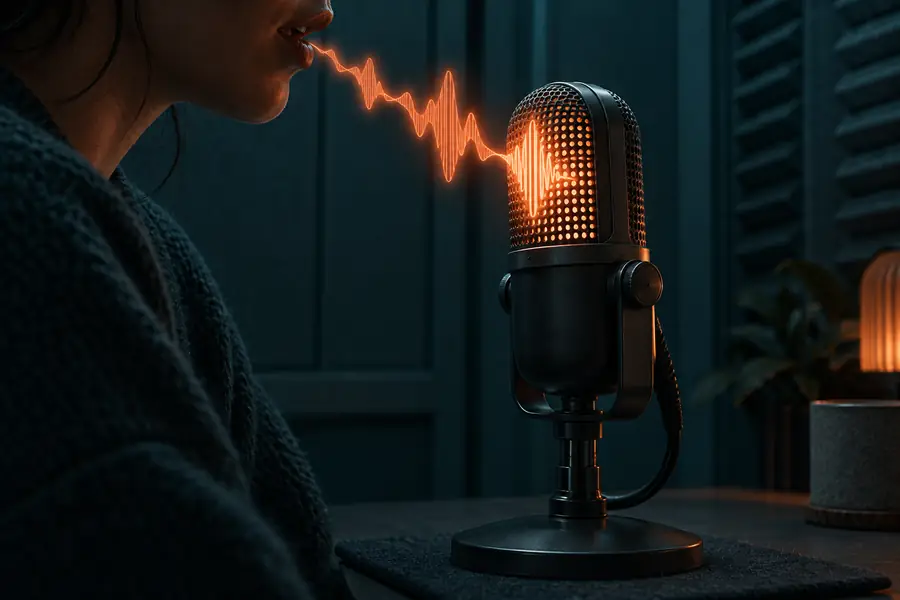
- Source recording
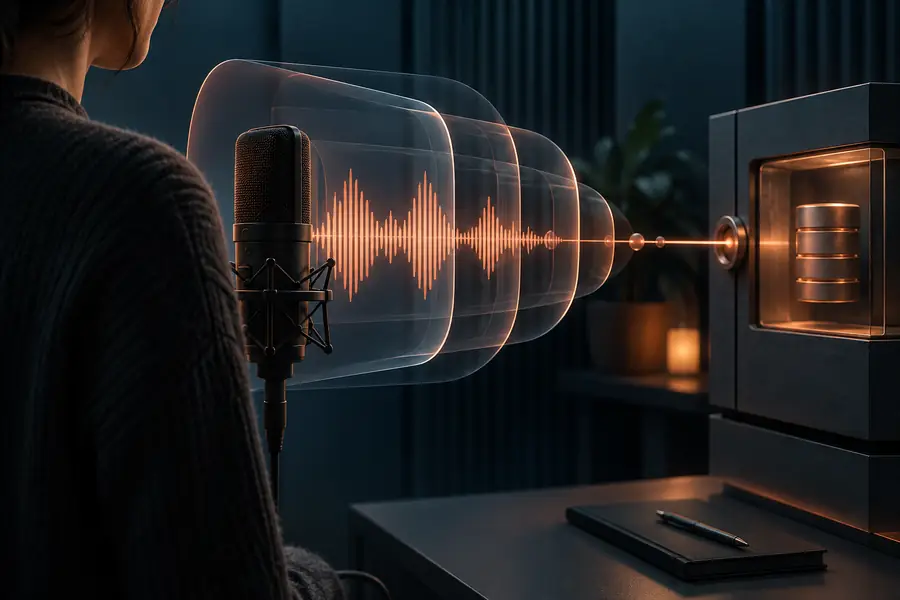
- Generated speech
The images illustrate two stages of the process, not a measured audio comparison or proof of consent. A source recording supplies characteristics for a voice clone; the generated speech can contain entirely new words. That distinction matters when a clip is shared without context.
boundary conditions
No tool can make a voice clone safe by itself. These limits depend on the speaker, the service, and where the finished audio goes.
-
Consent cannot be inferred
A tool cannot verify that you have the speaker’s informed permission merely because you possess an audio file. A voice clone of a family member, colleague, or public figure still needs an appropriate basis for use.
WorkaroundGet clear permission for the recording, intended script, and planned audience before uploading audio.
-
File handling varies
Voiceclone cannot promise how another service stores source recordings, generated speech, or related data. A safe decision requires reading that service’s current privacy and retention terms, particularly for sensitive recordings.
WorkaroundUse only audio you are comfortable sharing under those terms, and review any available removal controls.
-
Disclosure does not travel automatically
A caption identifying synthetic audio may be lost when someone downloads or reposts a voice clone. Listeners who encounter only the clip could mistake it for an authentic statement.
WorkaroundInclude a spoken disclosure when appropriate and avoid scripts that imply a real endorsement or event.
-
A familiar voice is not authentication
A voice clone can sound persuasive, so sound alone is a poor way to confirm a caller’s identity or authorize a request. This applies even when the audio seems to come from someone you know.
WorkaroundVerify unexpected requests through a separate, established contact channel.
when NOT to use it
Pause when consent or context is missing
Do not create or share a voice clone to impersonate someone, suggest they endorsed a message, bypass identity checks, or deliver words they would not knowingly approve. Avoid uploading confidential conversations or recordings containing other people without permission. If the speaker has agreed, the script is appropriate, and recipients will understand that the audio is synthetic, you can explore voice creation with those boundaries in place.
Explore voice creation- Ask the speaker before uploading
- Keep synthetic speech clearly identified
- Verify unexpected requests outside the audio
its own FAQ
Using your own voice removes the question of another speaker’s consent, but it does not remove storage or impersonation risks. Review where your recording goes, limit who receives the output, and be careful with scripts that could be mistaken for an authentic statement.
People often describe different situations: a disclosed creative project, an undisclosed imitation, and an identity-fraud attempt do not carry the same risks. Treat a personal account as a prompt to check consent, disclosure, and file handling—not as proof that every service or use is safe.
A publicly available recording may give someone source audio, although the result depends on the recording and the system used. Posting a clip does not grant permission to imitate you. If you find an unauthorized imitation, preserve evidence and report it through the platform where it appears.
No. A familiar-sounding voice is not enough to establish identity, especially if the caller asks for money, sensitive information, or urgent action. End the call and contact the person through a number or channel you already trust.
Disclosure helps listeners understand what they are hearing, but it does not replace the speaker’s permission or protect a confidential source recording. Consider the script, the audience, and the service’s handling of audio before generating or sharing it.